RARE MEDITATIONS ON THE EFFECTS OF SIEGES
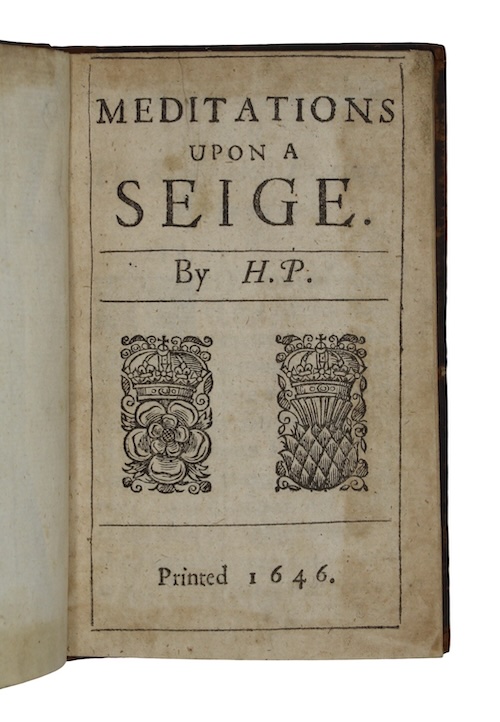
Meditations upon a seige.
[Oxford].
[Printed by Henry Hills], 1646.
First edition.
8vo.
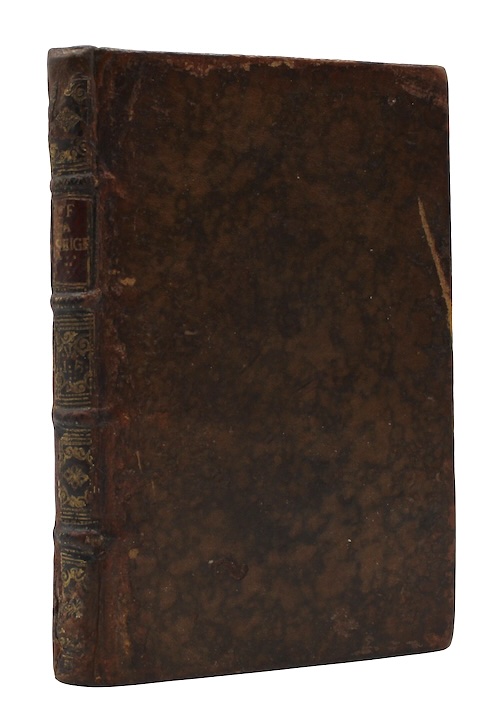
[8], 157pp, [1]. Contemporary mottled calf, expertly rebacked and recornered, with original spine laid down, contrasting morocco lettering-piece. A little worn to extremities, lettering-piece chipped, but very competently refurbished. Pastedowns sprung, a little browning internally, else a crisp copy.
'Rest is the great refreshment of decayed nature, whereby she recovers new strength and vigour, after she hath been spent and exhausted by tough labour of the body, by long continuous and multiplied dangers, by sharp and incessant cares, by alternate fears and hopes, by the vicissitudes and revolutions of comforts and discontents, which being violent and high in proportion to their causes and occasions, doe afflict the mind, and tyre and decay the spirits.'
A rare, evocative and entirely nuanced collection of 44 meditations on the military, social, economic and psychological impacts of siege warfare, printed in Oxford likely just after the lifting of the third siege there in 5 years.
Madan rather simplistically describes the work as 'a series of short sermons on the Art of Fortification. Each Part has a practical beginning and a moral end', before allowing that they 'collectively deal with all the aspects in which a siege presents itself to the combatants'. However, this inadequate summary rather misses the subtle point of the whole; a powerful collection of the manifold issues and effects that siege warfare has on both attacker and defender, by the author who had, as a King's Chaplain, incorporated at Oxford in August 1645, almost certainly experienced the siege firsthand:
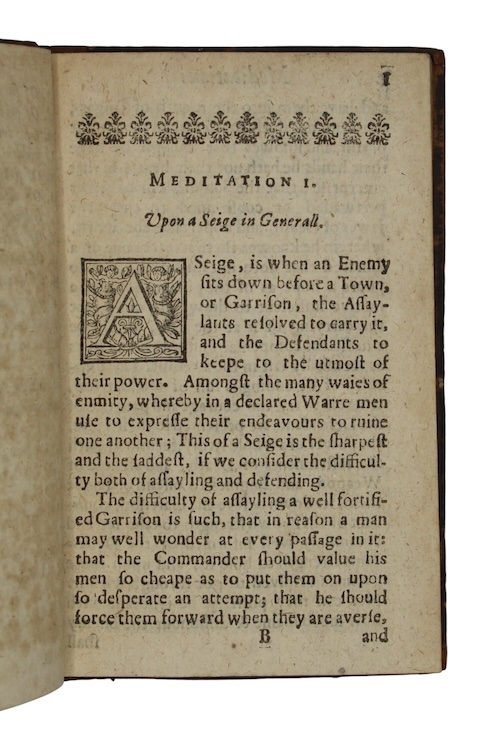
'Amongst the many waies of enmity, whereby in a declared Warre men use to expresse their endeavours to ruine one another; This of a Seige is the sharpest and the saddest, if we consider the difficultly both of assayling and defending'.
Madan's short synopsis focuses upon the practical and military aspects of this work: 'The 10th, 20th, 30th and 40th meditations, for example, are of shooting-stones, of trenches and batteries, of case shot, of stripping (prisoners)', but fails to mention those elements of the work which set it apart as a work of literature or social history, rather than a military guide. Thankfully, more recent scholarship has reappraised the piece. George Turner's Humphrey Peake and Siege Warfare (Midlands Historical Review, Vol. 2, 2018) goes so far as to suggest that 'Peake's work has been sorely overlooked by historians, with his conscious appreciation of the socio-economic side of sieges making Meditations a source that should be held in much higher esteem'. It draws attention specifically to the psychological effects of hunger (which Peake calls 'the cruellest engine whereby to subdue the strongest resolutions') and the need for constant alertness, resulting in the besieged experiencing trauma both physical and mental.
Biographical details of the author are scant aside from those recorded in public records. Cambridge alumni records suggest he was born in 1592, and matriculated at Trinity College in 1613, before proceeding as a scholar (1614), BA (1617), and finally MA (1621), after he had been ordained both deacon (1619) and priest (1620). His high-church views did not harm his clerical career; he was made a prebend of Lincoln (1626-45), the Rector of Acrise, in Kent, from 1627 - the same year he was appointed a Chaplain to the King - and served as a Canon of Canterbury Cathedral from 1633 until his ejection in 1645. At this point he clearly travelled to the King's court in Oxford, and was incorporated as Doctor of Divinity in August of 1645; the year of his death.
Rare both commercially and institutionally. This very copy, previously in the Cottesloe military library - 'probably the most extensive private collection of early printed books focused on military matters', assembled by Thomas Francis Fremantle, 3rd Lord Cottesloe (1862-1965) - is the only example that we could locate as having troubled the gavel in the rooms. Similarly, ESTC locates copies at just three libraries worldwide: BL, Cambridge and Oxford.
A rare, evocative and entirely nuanced collection of 44 meditations on the military, social, economic and psychological impacts of siege warfare, printed in Oxford likely just after the lifting of the third siege there in 5 years.
Madan rather simplistically describes the work as 'a series of short sermons on the Art of Fortification. Each Part has a practical beginning and a moral end', before allowing that they 'collectively deal with all the aspects in which a siege presents itself to the combatants'. However, this inadequate summary rather misses the subtle point of the whole; a powerful collection of the manifold issues and effects that siege warfare has on both attacker and defender, by the author who had, as a King's Chaplain, incorporated at Oxford in August 1645, almost certainly experienced the siege firsthand:
'Amongst the many waies of enmity, whereby in a declared Warre men use to expresse their endeavours to ruine one another; This of a Seige is the sharpest and the saddest, if we consider the difficultly both of assayling and defending'.
Madan's short synopsis focuses upon the practical and military aspects of this work: 'The 10th, 20th, 30th and 40th meditations, for example, are of shooting-stones, of trenches and batteries, of case shot, of stripping (prisoners)', but fails to mention those elements of the work which set it apart as a work of literature or social history, rather than a military guide. Thankfully, more recent scholarship has reappraised the piece. George Turner's Humphrey Peake and Siege Warfare (Midlands Historical Review, Vol. 2, 2018) goes so far as to suggest that 'Peake's work has been sorely overlooked by historians, with his conscious appreciation of the socio-economic side of sieges making Meditations a source that should be held in much higher esteem'. It draws attention specifically to the psychological effects of hunger (which Peake calls 'the cruellest engine whereby to subdue the strongest resolutions') and the need for constant alertness, resulting in the besieged experiencing trauma both physical and mental.
Biographical details of the author are scant aside from those recorded in public records. Cambridge alumni records suggest he was born in 1592, and matriculated at Trinity College in 1613, before proceeding as a scholar (1614), BA (1617), and finally MA (1621), after he had been ordained both deacon (1619) and priest (1620). His high-church views did not harm his clerical career; he was made a prebend of Lincoln (1626-45), the Rector of Acrise, in Kent, from 1627 - the same year he was appointed a Chaplain to the King - and served as a Canon of Canterbury Cathedral from 1633 until his ejection in 1645. At this point he clearly travelled to the King's court in Oxford, and was incorporated as Doctor of Divinity in August of 1645; the year of his death.
Rare both commercially and institutionally. This very copy, previously in the Cottesloe military library - 'probably the most extensive private collection of early printed books focused on military matters', assembled by Thomas Francis Fremantle, 3rd Lord Cottesloe (1862-1965) - is the only example that we could locate as having troubled the gavel in the rooms. Similarly, ESTC locates copies at just three libraries worldwide: BL, Cambridge and Oxford.
ESTC R216916, Madan II, p.333, Wing P966B.
£ 4,500.00
Antiquates Ref: 32118