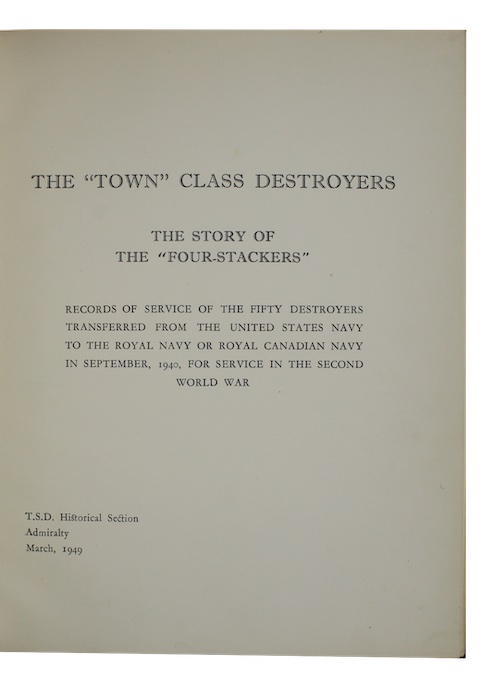
The "town" class destroyers: the story of the "four-stackers"...
[Bath].
[H. Sharp & Sons], [1949].
First edition.
Quarto.
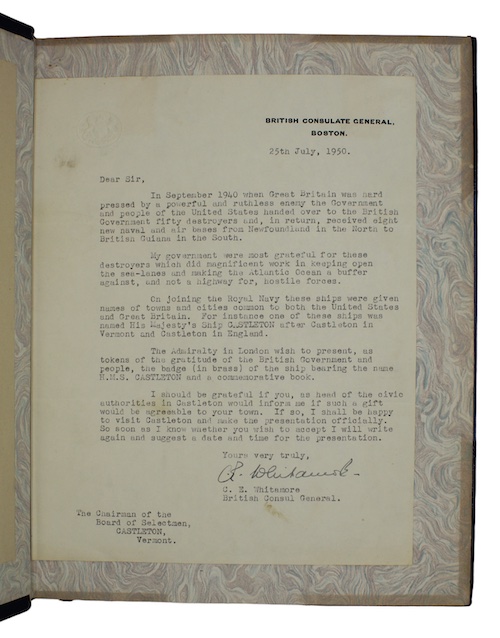
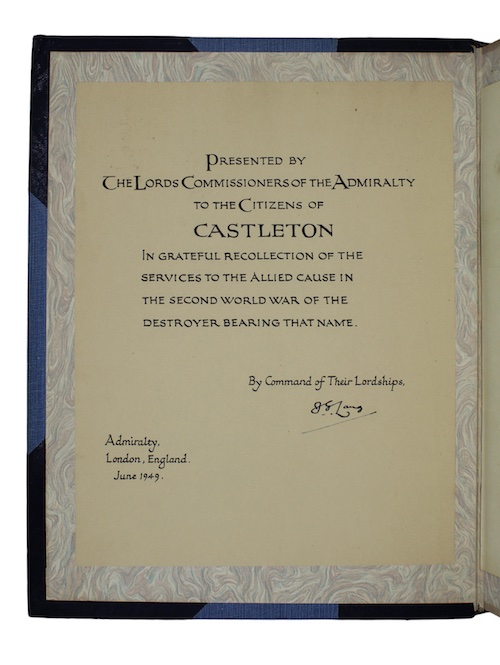
107pp, [1]. With fifty mounted photographs. Bound for presentation in contemporary navy half-morocco, blue cloth boards, gilt lettering and nautical motifs to spine, T.E.G. Lightly rubbed and marked. Marbled endpapers, internally clean and crisp. Presentation plate to FEP: 'Presented by the Lords Commissioners of the Admiralty to the citizens of Castleton in grateful recollection of the services to the allied cause in the Second World War of the destroyer bearing that name'. T.L.S. dated 25th July, 1950 pasted to recto of FFEP; addressed by British Consul General C. E. Whitamore to an unnamed Castleton civic servant, offering to confer the book (and a brass badge of the H.M.S. Castleton) at an official presentation. Blind-stamp to front blank fly-leaf of educator, amateur historian, and sometime resident of Castleton (where he graduated Teachers College in 1957), Douglas Ronald Monmaney (1934-2006).
The records of service of the fifty destroyers transferred from the United States Navy to the Royal Navy or Royal Canadian Navy in September, 1940 - each bearing the name of a North American town.
H.M.S. Castleton saw active duty in the North Atlantic as a convoy escort. In November 1940 she picked up all the survivors of two torpedoed steamships, Daydawn and Victoria. On 20th August 1942 she and H.M.S. Newark captured 51 survivors of the German submarine U-464 who had taken refuge in an Icelandic trawler. She was reduced to reserve at Grangemouth, Scotland, in 1945 and sold for scrap in 1947.
There is seemingly no record of how many copies were issued, nor indeed if one was distributed to each of the fifty towns associated with a destroyer.
OCLC records copies at six locations (Canadian Museum of History, Florida, Land Public Library, Navy Department, Rowan Public Library, and Victoria); COPAC adds no further.
£ 250.00
Antiquates Ref: 26602
H.M.S. Castleton saw active duty in the North Atlantic as a convoy escort. In November 1940 she picked up all the survivors of two torpedoed steamships, Daydawn and Victoria. On 20th August 1942 she and H.M.S. Newark captured 51 survivors of the German submarine U-464 who had taken refuge in an Icelandic trawler. She was reduced to reserve at Grangemouth, Scotland, in 1945 and sold for scrap in 1947.
There is seemingly no record of how many copies were issued, nor indeed if one was distributed to each of the fifty towns associated with a destroyer.
OCLC records copies at six locations (Canadian Museum of History, Florida, Land Public Library, Navy Department, Rowan Public Library, and Victoria); COPAC adds no further.