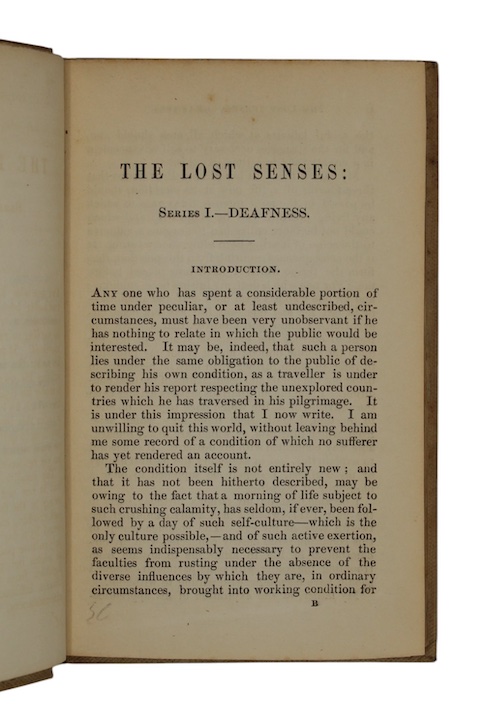
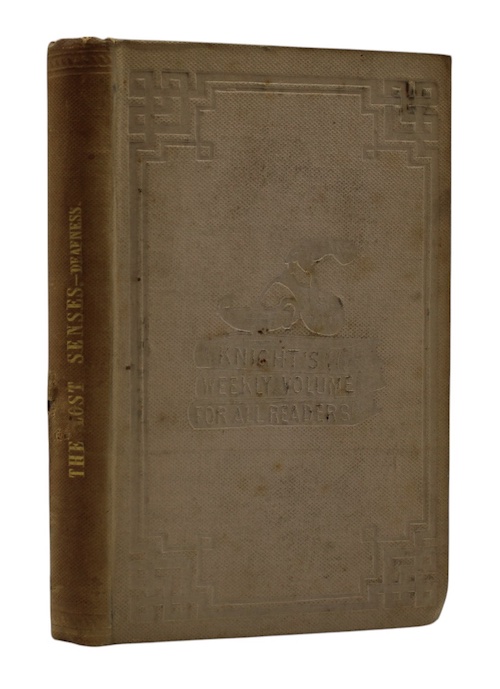
The lost senses. Series I. - deafness.
London.
Charles Knight, 1845.
First edition.
12mo.
[2], 206pp. With a half-title. Original publisher's blind-stamped tan cloth, lettered in gilt. Heavily sunned, lightly rubbed and marked. Internally clean and crisp.
The first edition of John Kitto's (1804-1854) autobiographical study on deafness, first in the series titled 'The Lost Senses', and described as a 'cultural history of deafness and blindness' (Stoddard Holmes). Wilkie Collins based his representation of disability in Hide and Seek (1854) on the contents of this volume, and its sequel on blindness. Kitto, who lost his hearing at age 12 after a fall, was already a respected writer, and explores in this volume the ways in which deafness had allowed him to hone his literary abilities and move from poverty to wealth as a writer of religious texts.
The writing, however, does not shy away from the experimental, and often cruel, world of Victorian medical approaches to deafness. Although at the time of writing Kitto expresses an acceptance of his condition, as a child he had been subject to a great range of medical treatments which are recounted in detail - 'They poured into my tortured ears various infusions, hot and cold; they bled me, they blistered me, leeched me, physicked me; and, at last, they put a watch between my teeth, and on finding that I was unable to distinguish the ticking, they gave it up as a bad case, and left me to my fate.'
£ 125.00
Antiquates Ref: 19731
The writing, however, does not shy away from the experimental, and often cruel, world of Victorian medical approaches to deafness. Although at the time of writing Kitto expresses an acceptance of his condition, as a child he had been subject to a great range of medical treatments which are recounted in detail - 'They poured into my tortured ears various infusions, hot and cold; they bled me, they blistered me, leeched me, physicked me; and, at last, they put a watch between my teeth, and on finding that I was unable to distinguish the ticking, they gave it up as a bad case, and left me to my fate.'